Course contents
- 01How fibres become yarn: the spinning process from bale to cone
- 02Yarn count systems: Ne and Tex, and how to convert between them
- 03Ply and twist: what a yarn's construction number and twist direction mean
- 04Combed vs carded yarn: what the process removes and why it costs more
- 05Calculating yarn requirements for an order from fabric weight and construction
How fibres become yarn: the spinning process from bale to cone
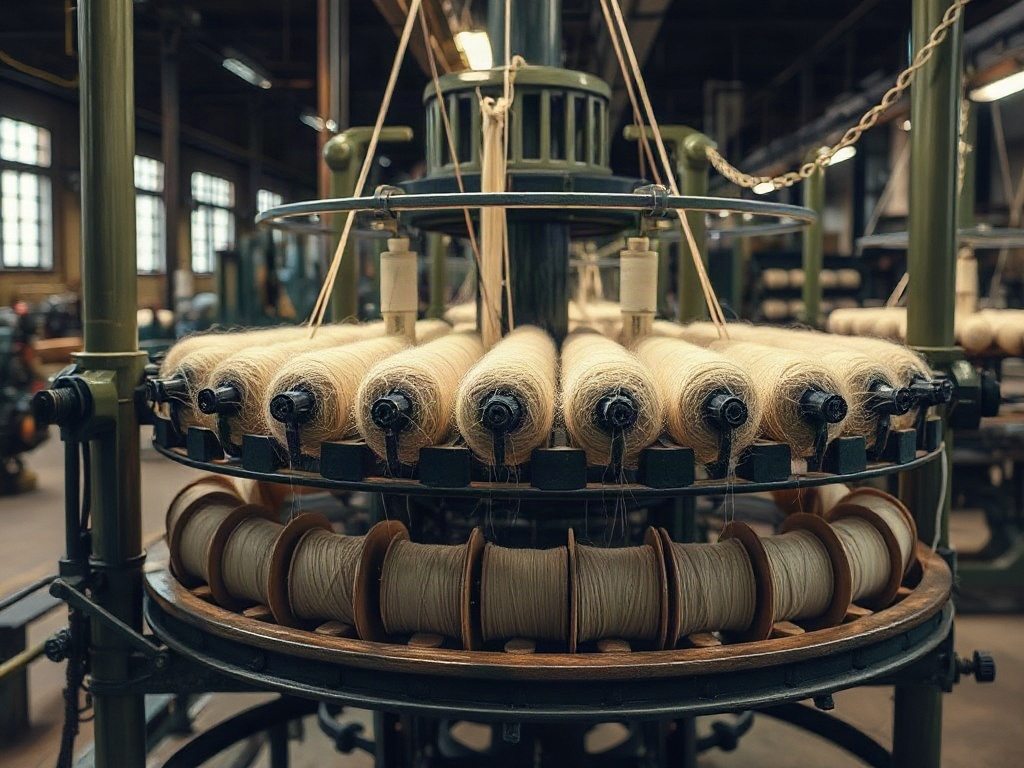
This page explains the sequence of stages that turns raw fibre into yarn, for anyone who reads a fabric or yarn specification
This page explains the sequence of stages that turns raw fibre into yarn, for anyone who reads a fabric or yarn specification: a merchandiser, a production team, a buyer, a textile mill employee, or a new entrant to the trade. This lesson teaches product flow: how a bale of raw fibre becomes the finished yarn a knitting or weaving mill buys by weight.
A person new to the trade often talks about "spinning" as one single step, done in one machine, in one motion. It is not. Spinning is a sequence of separate stages, each doing a specific job to the fibre, each able to go right or wrong on its own. A spinning mill such as Nile Spinning runs every one of these stages before a single cone of finished yarn is ready to ship.
Without this, a merchandiser who hears "the spinning went wrong" cannot ask a useful question, since there is no single "the spinning" to name. A production manager investigating a yarn fault who does not know the stages wastes time checking the wrong part of the process. Knowing the sequence, in order, is the first tool anyone needs before diagnosing a yarn problem.
What you need, and what this lesson does not cover
You need: Course 2 of this track (Man-Made and Synthetic Fibres) is useful background, specifically knowing that a fibre has a starting material before it becomes yarn. Not required to follow this lesson.
By the end of this lesson you can:
- name the main stages raw fibre passes through to become yarn, in the correct order;
- explain what each stage does to the fibre, in plain words;
- place the combed-or-carded decision at the correct point in the sequence;
- name Nile Spinning's role in producing the yarn that becomes Order A's fabric;
- ask "which stage does this belong to" as the first question for any yarn-quality problem.
Not covered here: how a yarn's count (its thickness number) is written and converted between systems (lesson T02-C03-L02); what ply and twist direction mean (lesson T02-C03-L03); what combing removes and why it costs more, in depth (lesson T02-C03-L04); calculating the yarn weight an order needs (lesson T02-C03-L05).
Words you will meet in this lesson
| Term | Meaning |
|---|---|
| Opening and cleaning | The first stage: bales of raw fibre are opened up and impurities such as leaf and trash are removed. |
| Carding | The stage that combs fibres into a thin web, then forms that web into a rope-like strand called a sliver. |
| Sliver | A loose, rope-like strand of roughly aligned fibres, produced by carding, before it is drawn out or spun. |
| Combing | An optional stage, after carding, that removes the shortest fibres from the sliver for a smoother, stronger yarn. |
| Drawing | The stage that combines several slivers and draws them out thinner, evening out the fibre distribution along their length. |
| Roving | A thinned, lightly twisted strand made after drawing, twisted just enough to hold together before final spinning. |
| Winding | The final stage: finished yarn is wound onto cones ready to ship to a knitting or weaving mill. |
| Cone | The wound package of finished yarn a spinning mill ships to its customer. |
Spinning is a sequence of separate stages, not one single step, and each stage does one specific job to the fibre
Spinning is not one step; it is a sequence of stages, and a raw bale of fibre passes through every one of them before it becomes finished yarn. First, the fibre is opened and cleaned. Second, it is carded into a web and then a sliver. Third, it may optionally be combed. Fourth, several slivers are drawn out and given a slight twist as roving. Fifth, the roving is spun with its final twist into yarn. Sixth, the yarn is wound onto cones. Skipping or rushing any one stage shows up later as a yarn fault, because each stage corrects or prepares the fibre for the one after it.
The variants a spinning mill actually meets at each stage, and why they matter
The sequence itself never changes, but what happens inside each stage, and whether a stage is included at all, changes with the yarn a mill is producing.
| What can differ | The shapes you meet | Why it matters to you |
|---|---|---|
| Opening and cleaning, by fibre cleanliness | A higher trash-grade raw cotton (Course T02-C01-L02) needs more thorough opening and cleaning before carding; a cleaner bale needs less. | A dirty bale that skips thorough cleaning carries impurities into every later stage, where they are far harder to remove. |
| Combing, included or skipped | Combed yarn, like Order A's Ne 30/1 combed cotton, adds the combing stage after carding; carded yarn skips it entirely and goes straight to drawing. | Skipping combing is a real, common choice, not a shortcut error; it produces a cheaper, less smooth yarn, covered in lesson T02-C03-L04. |
| Drawing and roving, for blended yarns | A single-fibre yarn draws slivers of one fibre; a blended yarn, such as a cotton-elastane blend, combines slivers of more than one fibre at the drawing stage to reach an even blend ratio. | The drawing stage is where a blend is actually created, not just where evenness is fixed; getting the blend wrong here cannot be corrected later. |
| Business model, by how the mill plans production | A make-to-order mill runs the sequence against a confirmed order, like Nile Spinning supplying Order A's Ne 30/1 yarn; a make-to-stock mill runs the same sequence against its own forecast, holding finished cones in stock before any order arrives; a hybrid mill mixes both. | The stages a mill runs never change with its business model; only when it runs them, against an order or against a forecast, changes. |
| Market, export or domestic | An export mill selling to a knitting mill in another country, like Nile Spinning supplying Rowad Knits for Order A, runs the identical six-stage sequence as a mill selling the same yarn to a domestic knitter; only the shipping and paperwork after winding differ. | The sequence that makes the yarn is not an export or domestic question at all; it is fixed by the fibre and the yarn specification. |
| Product family, beyond a T-shirt's cotton yarn | The same six-stage sequence spins the yarn used in socks and hosiery, in knit-to-garment products, and in home-textile yarns for towels or bedding, not only apparel fabric yarn. | Whatever the final product, its yarn passed through the same opening, carding, optional combing, drawing, spinning and winding stages first. |
Nile Spinning runs the full sequence to produce the Ne 30/1 combed cotton yarn for Order A
This course follows Order A: 15,000 basic cotton T-shirts that Delta Garments makes for Northline Apparel, an export order sold made to order. Before Delta Garments ever sees fabric, Nile Spinning, the spinning mill in this academy's cast, runs the exact sequence this lesson teaches to produce Order A's yarn: Ne 30/1 combed cotton. Nile Spinning opens and cleans its raw cotton, cards it into sliver, combs it because Order A specifies combed yarn, draws and roves it for evenness, spins it with final twist to Ne 30/1, then winds it onto cones. Those cones are what Nile Spinning sells, by weight, to Rowad Knits, the knitting mill that turns the yarn into Order A's single jersey fabric.
A sequencing exercise: putting the five main stages of spinning into their correct order
No new calculation is needed for this lesson. Instead, the worked example is a sequencing exercise. Given the main stages out of order, sort them into the sequence raw fibre actually follows, then place the combed-or-carded decision at its one correct point.
| Position | Stage | Where the combed/carded decision sits |
|---|---|---|
| 1 | Opening and cleaning | |
| 2 | Carding | |
| 3 | [Combing] | Immediately after carding, before drawing |
| 4 | Drawing and roving | |
| 5 | Spinning and winding |
Placing combing anywhere else, such as before carding or after drawing, is not a real option a mill can choose; combing only works on a sliver that carding has already produced, and drawing needs to already know whether it is drawing a combed or a carded sliver.
The methodA one-question test for any yarn-quality problem: which stage does this issue belong to
- Ask what kind of problem the yarn shows. Cleanliness, short-fibre content, evenness, or strength and twist are the four broad problem types.
- If the problem is fibre cleanliness, check opening and cleaning first. Trash or impurity content points back to this earliest stage.
- If the problem is short-fibre content, check carding and combing. These are the two stages that remove or fail to remove short fibres.
- If the problem is evenness along the yarn's length, check drawing and roving. This is the stage responsible for combining and drawing out slivers to even them.
- If the problem is strength or twist, check spinning itself. Final twist and strength are set at this last stage, not earlier.
- Never blame "the spinning" as a whole until one specific stage has been checked and ruled in or out.
A common mistake is treating spinning as a single, unified black-box step instead of a sequence of separate stages
A common mistake is to treat "spinning" as one unified black-box step, so that when a yarn-quality problem appears, the first reaction is to blame "the spinning" in general rather than naming a specific stage. This costs real time: a merchandiser or production manager who jumps straight to "the spinning was bad" without asking which stage caused the fault can spend inspection time checking the wrong part of the process, or send a batch back to be re-spun entirely when only one stage, such as drawing, actually needs attention. Naming the exact stage first, before assigning blame, is the difference between a fast, targeted fix and a wasted inspection cycle.
Making yarn from raw fibre is not one step; it is six stages, always in the same order. First, bales of raw fibre are opened up and cleaned of leaf and dirt. Second, the fibre is combed into a web and rolled into a rope-like strand called a sliver. Third, the sliver may optionally be combed again to remove the shortest fibres, or that step may be skipped for a cheaper yarn. Fourth, several slivers are combined and drawn out thinner for evenness, then given a slight twist as roving. Fifth, the roving is spun with its final, full twist into yarn. Sixth, the finished yarn is wound onto cones ready to ship. When a yarn problem shows up, the useful question is never "what went wrong with the spinning" but "which one of these six stages caused it".
- Spinning is a sequence of six stages, not one single step.
- The stages, in order: opening/cleaning, carding, [combing], drawing/roving, spinning, winding.
- Combing is the only optional stage; it sits immediately after carding, before drawing.
- A cleanliness problem points to opening and cleaning; a short-fibre problem points to carding or combing.
- An evenness problem points to drawing and roving; a strength or twist problem points to spinning itself.
- Never diagnose a yarn fault by blaming "the spinning" as a whole; name the exact stage first.
Nile Spinning's production log flags Batch 447 for uneven thickness along its length, with combing already confirmed normal
Nile Spinning's quality team is reviewing a production log entry for a batch of Ne 30/1 combed cotton yarn, the same yarn specification Order A uses. The facts in front of the team:
- The batch is flagged for uneven thickness along its length, not for dirt, short fibres, weak strength or poor twist.
- The combing stage for this batch has already been checked and confirmed normal.
- The batch has already passed through opening and cleaning, carding, and combing before this flag was raised.
The document the team reads, one line from Nile Spinning's production log:
Given that combing is confirmed normal, which stage should be checked next for an evenness problem? Decide before you open the answer.
Show decision
Drawing and roving. Two facts, together, point here and nowhere else.
First, what the problem actually is. Uneven thickness along the yarn's length is an evenness problem, not a cleanliness, short-fibre, strength or twist problem; this lesson's method routes an evenness problem specifically to drawing and roving, the stage responsible for combining and drawing out multiple slivers to even out fibre distribution.
Second, what has already been ruled out. Combing, an earlier stage in the sequence, is confirmed normal, so a short-fibre cause is already ruled out. Spinning itself, the stage after drawing, sets twist and final strength, not evenness, so it is not the next stage to check either.
The team should check drawing and roving next, not re-inspect combing again and not jump ahead to spinning. Checking the wrong stage here would waste inspection time and risk a second uneven batch reaching Rowad Knits before the real cause, most likely uneven drawing, is found.
What checking the wrong stage for a yarn fault costs in inspection time and downstream risk
This lesson's cost is framed qualitatively, in inspection time and downstream risk, because no single dollar figure is fixed for a yarn-fault investigation. If Nile Spinning's team investigates the wrong stage for Batch 447's evenness problem, for example re-checking combing again or inspecting the spinning stage instead of drawing, it wastes inspection time without finding the real cause.
The real risk is not only wasted time: while the wrong stage is being checked, a second batch can pass through drawing with the same uneven fault and reach Rowad Knits before anyone finds the cause. Naming the correct stage first, using the one-question test in this lesson's method, is what keeps that risk from compounding across more of the 3,075 kg Order A needs.
Yarn calculator: the workbook this course uses, and the stage checklist this lesson fills in first
This lesson's exercise is a sequence, not a calculation, so the working template here is a simple stage checklist: copy the six stages in order, tick each one off as you confirm it for a real batch, and mark whether combing was included or skipped. Use this checklist as the first line of any yarn-quality investigation, before reaching for a number.
| Stage | Included on this batch? | Checked and confirmed normal? |
|---|---|---|
| Opening and cleaning | ||
| Carding | ||
| Combing (optional) | ||
| Drawing and roving | ||
| Spinning and winding |
From lesson T02-C03-L02 onward, this course's real calculations, converting a yarn's count, calculating yarn requirements, and estimating raw-cotton input, are done in the same workbook.
[Download: Yarn calculator](templates/T02-C03-yarn-calculator.xlsx)
1. What is the correct order of the main spinning stages?
2. Where does the combed-or-carded decision belong in the spinning sequence?
3. A domestic knit order for Cedar & Co. shows a yarn batch with poor strength and inconsistent twist, but even thickness along its length and no cleanliness or short-fibre complaints. Which stage should be checked first?
| EN | AR | FR | TR | Meaning |
|---|---|---|---|---|
| Opening and cleaning | الفتح والتنظيف | Ouverture et nettoyage | Açma ve temizleme | The first stage: bales of raw fibre are opened up and impurities such as leaf and trash are removed. |
| Carding | القرد (التمشيط الأولي) | Cardage | Karde işlemi | The stage that combs fibres into a thin web, then forms that web into a rope-like strand called a sliver. |
| Sliver | الشريط الليفي (السليفر) | Ruban (sliver) | Şerit (sliver) | A loose, rope-like strand of roughly aligned fibres, produced by carding, before it is drawn out or spun. |
| Combing | التمشيط | Peignage | Tarama (penye) işlemi | An optional stage, after carding, that removes the shortest fibres from the sliver for a smoother, stronger yarn. |
| Drawing | السحب | Étirage | Çekme (drawing) | The stage that combines several slivers and draws them out thinner, evening out the fibre distribution along their length. |
| Roving | الروفنغ (الشريط المبروم قليلاً) | Mèche (roving) | Fitil (roving) | A thinned, lightly twisted strand made after drawing, twisted just enough to hold together before final spinning. |
| Winding | اللف على البكرات | Bobinage | Bobin sarma | The final stage: finished yarn is wound onto cones ready to ship to a knitting or weaving mill. |
| Cone | البكرة (الكونـز) | Cône | Koni (bobin) | The wound package of finished yarn a spinning mill ships to its customer. |
Lesson 3.2: Yarn count systems: Ne and Tex, and how to convert between them
You now know the sequence of stages that turns raw fibre into yarn. The next lesson opens one number from that sequence in detail: how a yarn's thickness is written as a count, in the Ne system or the Tex system, and how to convert between the two. Back to the course map